

It’s been very interesting to see the clips of various commencement speakers espousing the inevitability of AI to a room full of graduates only to be greeted with a round of booing or jeers. And what’s even more fascinating is how *shocked* some of them seem to be by this response.
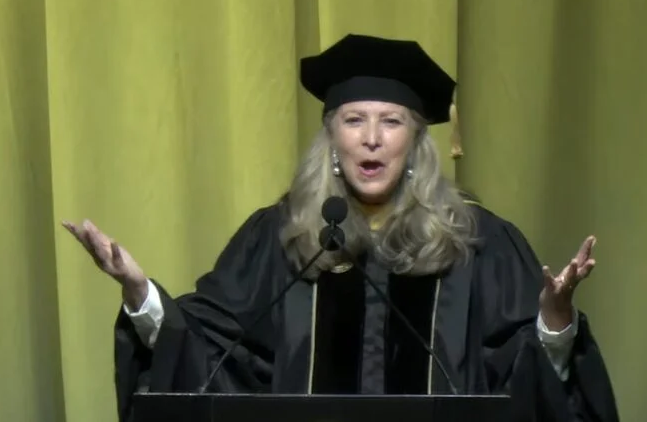
Now let’s set aside the obvious stupidity of consciously choosing to craft a speech to a group of humanities students about the very technology everyone is telling them is going to make their professional dreams disappear. Honestly, the woman above at least should have expected this. But I want to focus on the very real discourse that’s been permeating the media and beyond that likely led speakers like this woman (and former Google CEO Eric Schmidt and beyond) to believe that they were, in fact, being inspirational.
Did everyone else clock the backlash to Reese Witherspoon posting on social media about women learning how to use AI? It was fascinating to watch unfold. Reese posted a reel about how she doesn’t want women to get left behind in this next technological revolution. And how we need to learn how to harness AI now before we pay the price (in the form of fewer professional opportunities, I presume) later. Critiques started flying in. People couldn’t believe that an actor — an artist — would preach about the importance of a technology that was threatening her own career. As often happens with these fast-moving online campaigns, it wasn’t long before people began claiming that she must have been paid to say this. Surely it wasn’t her own opinion, right?
And then she actually responded! She posted another video, this time acknowledging people’s concerns. But also doubling down that she was committing to learning how to leverage this technology. She would not be left behind. But you will be. Or at least that’s the subtext.
So why are so many people pounding their chests, declaring as loudly as possible that AI IS INEVITABLE and you better get on the train before it leaves without you? Is it truly because they — out of the goodness of their hearts — want to make sure we’re all in this together?
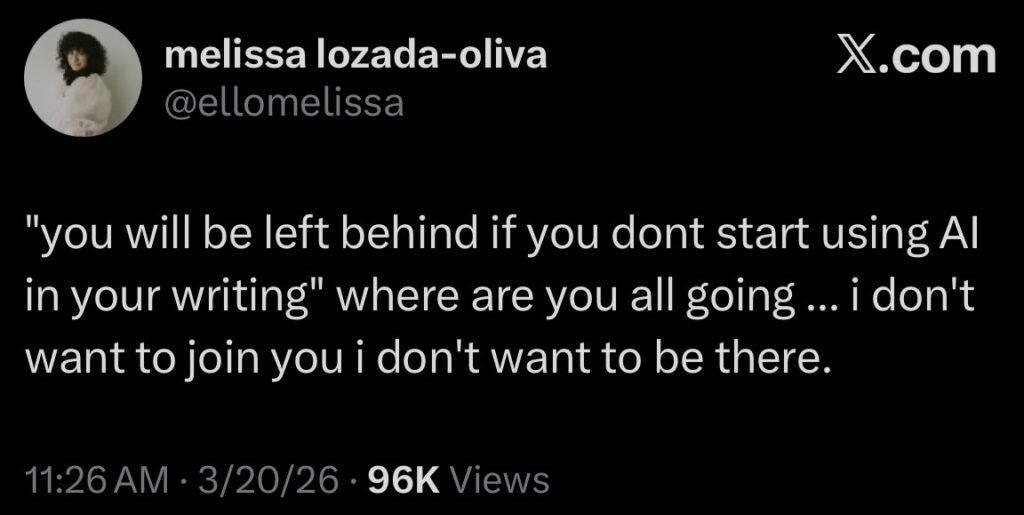
I’m going to call bullshit on that one. Since when has society expended significant energy to ensure that people aren’t left behind? Sure, the proliferation of different types of influence on social media certainly could result in some genuinely well-meaning individuals trying to sound the alarm so that people have time to adjust and find their new professional niches in a new era of technology. But the majority? I remain doubtful. The same way I can acknowledge that AI companies building consumer tools are obviously trying to convince you that you need them to complete tasks you’ve been doing yourself your entire life…
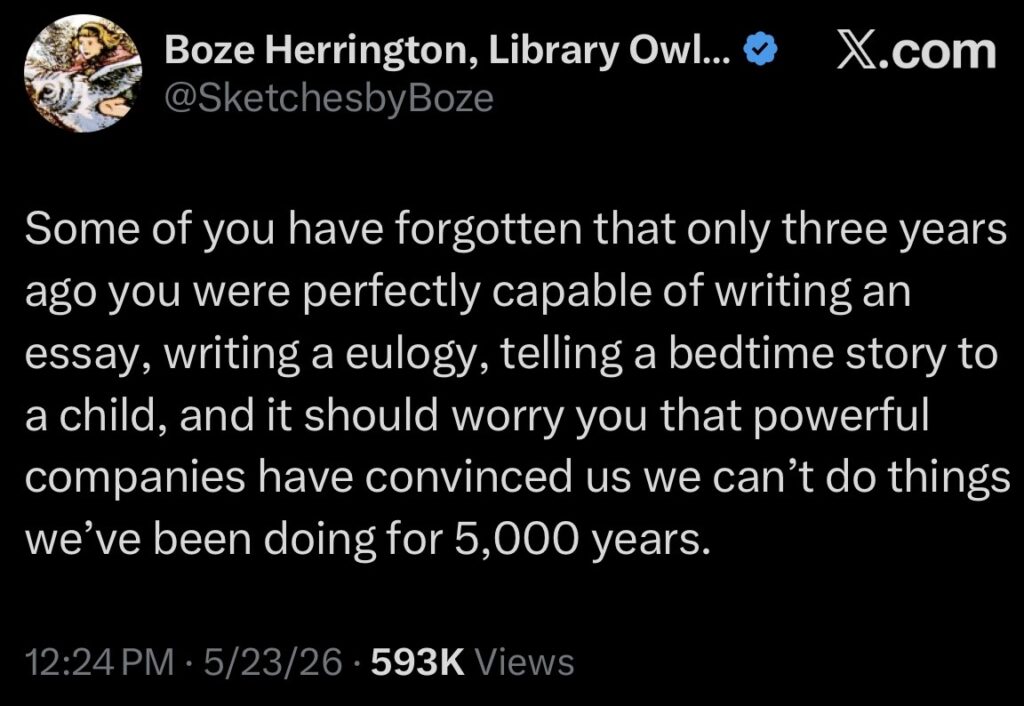
…while still understanding that it’s not a vast conspiracy — merely capitalism at work (likely fueled by a healthy dose of bot traffic). I’m sure some of these posters are actually just attempting to farm engagement for their own accounts. Or jumping on whatever bandwagon feels most lucrative to get their opinions shared (if anyone has any tips on how to get their writing shared by not rage baiting others, pls pass them along). But the result is the same: a critical mass of people are now proclaiming that “AI is inevitable” and they expect us to cheer.
But what exactly does AI is inevitable even mean?? This is where I want to dig in. Because like any pithy headline these days, it actually means nothing without context.
Like any pithy headline these days, [AI Is Inevitable] actually means nothing without context.
I personally think the reason these commencement speakers are getting booed offstage (okay fine, not offstage but you get what I mean) is that most people, maybe even some speakers included, don’t even really understand what AI is supposedly — inevitably — going to accomplish. All they see is the very real discourse around consumer-based tools like ChatGPT. That they probably use themselves to write emails. Or deepfakes and disgusting images created by Grok. It makes sense, these are the applications of AI that we can most easily observe in our day-to-day. But they’re actually the least important.
What even is AI anyway?
No need for a vast lecture here, but tl;dr…Artificial Intelligence is a blanket term that, truthfully, means very little.
ChatGPT, Claude, Gemini etc are large language models (LLMs). And LLMs are actually a type of neural networks, a term that is likely foreign to anyone who hasn’t worked in some tech or tech-adjacent field. But those who have know that AI has conceptually been around for a very long time. The umbrella of technologies broadly defined as “AI” generally refers to any sort of computational system that is designed to try to mimic some type of human functioning — like logic, reason, decision making, and the like.
Engineers, startup founders, and everyone in between have been trying to find ways to use AI-driven technologies to solve problems (and make tons of money) for years. But the launch of ChatGPT in 2022 changed the conversation. Let me reiterate that — more than anything else, the launch of ChatGPT changed the conversations being had about AI more than any actual technological innovation.
More than anything else, the launch of ChatGPT changed the conversations being had about AI more than any actual technological innovation.
Suddenly this was something that people could grasp. That they could see. Use. Learn from (wishful thinking, I know). Here was a tool that would help the everyman level up their own personal systems. And if there’s a surefire way to drum up excitement for a new product or technology, it’s to tell people that it will do one of the following:
- Make their life easier
- Make them seem smarter
- Make them more money
And that is precisely what LLMs like Chat market themselves as being able to do. But do they actually accomplish any of this?
So far, studies are pretty small and new — and starting to lean negative — on the consumer front. People have reacted predictably, as humans do. When given a shiny new toy that promises efficiency and convenience, they use it without much discernment. And thus end up missing the true value underneath. Because the true potential of AI-driven technologies isn’t for the consumers. Or at least it’s not directly consumer-facing. Being able to create images with no artistic skill, or write a book without suffering through the process of getting to know your character’s motivations, or craft a difficult text to someone your computer will never have to look in the eye…these aren’t the ways this technology should be reshaping the world. In fact, I argue that these are at best a waste of valuable resources. And at worst a mechanism for a huge swath of our populace to become dumber.
Being able to create images with no artistic skill, or write a book without suffering through the process of getting to know your character’s motivations, or craft a difficult text to someone your computer will never have to look in the eye…[is just] a mechanism for a huge swath of our populace to become dumber.
But that doesn’t mean that all AI is evil. Quite the opposite. That sound you hear is my friends gasping, because I’m the first one to rail against consumer-driven AI use as it’s been proliferating. I genuinely loathe the ways that I see people abdicating their own decision making to these tools that weren’t designed to think — but rather to identify patterns and duplicate them in the most predictable manner. A literal reversion to the mean.
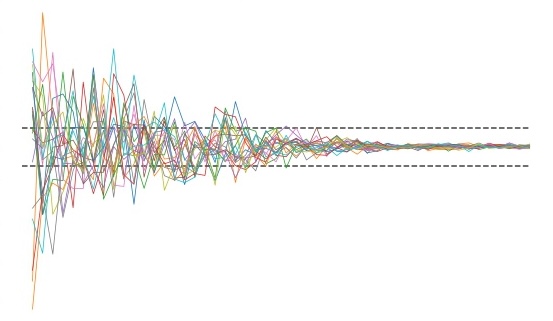
But the actual neural nets and LLMs and pattern matching tools that are being developed have real potential — the potential for real world impacts, that is. Not just accelerating humanity’s decline into semi-conscious sheepdom.
Imagine a system where anomalous cancerous cells are all stored and systematically analyzed for patterns, such that a doctor who has genuine expertise but lacks the ability to possess infinite information stored in their brain (even doctors are still human, sorry guys) receives an alert when they review a scan of a patient with a condition that they can’t quite identify. Or that could be one of three things, one of which is fatal while the other two are benign. An AI-driven tool could aid this doctor in identifying patterns beyond the scope of their practice to more intelligently classify this patient and prioritize future tests and hopefully their care. Freeing up time that the doctor might have had to spend tracking down the patterns on their own. And hopefully improving the odds that this patient would get the treatment they needed.
But you still need the doctor. This is where the current discourse around AI loses me. No matter how advanced this technology becomes, we are still a society of human beings. With vast differences as well as similarities. And with real desires — to connect, to learn, to be delighted.
No matter how advanced this technology becomes, we are still a society of human beings. With vast differences as well as similarities. And with real desires — to connect, to learn, to be delighted.
The above example is a softball, I admit it. That’s because the uses of AI-driven technologies are so vast when you eliminate the stupid ones. The ones that enable humans to appear creative without struggling to find inspiration. To be given validation without putting in the work. The only thing these consumer-facing tools are giving us is a way to blunt our own humanity. Instead, let’s allow them to flourish behind the scenes and drive real change.
I remain convinced that AI isn’t going to replace our humanity. At least, not unless we let it. But it very well might replace a lot of jobs. Hopefully the ones that rely on clunky and outdated backend systems and processing that are in real need of upgrades anyway.
Telling our graduates that their degrees are already obsolete is both incorrect and ridiculously cruel. Because a college degree was never about just acquiring a particular skill. It’s about learning — learning about learning. People with strong educational backgrounds should be best positioned to find opportunities as AI reshapes certain parts of our professional landscape because they have (hopefully) been equipped with real critical thinking skills. Discernment and reasoning are more important than ever when technological advances are shifting the ground underneath our feet.
That’s what I wish these graduation speakers had focused on. The real lasting impact of an education that will enable these young people to harness new technologies — any new technologies that arise — with intention rather than abandonment. The graduates entering the workforce now have the opportunity to shape their futures the same way the generations before them did. Maybe even more. Because these technologies are real, and they’re here. And they’re inevitable, in their own way. But not how the media or these speakers or Sam Altman would lead you to believe. Not unless you let them scare you into submission.
So that’s my final plea, not just to graduates but to everybody: don’t let these tools take away your free will. Instead, use them to find ways to enhance your own job or your own life. And don’t forget…for the majority of us, we were operating just fine before any of these tools were at our disposal. We could write emails and plan trips and research historical events. Even have entire conversations without saying “let me ask Chat…” In my opinion, the absolute coolest applications of AI aren’t anything that you or I are going to find by outsourcing our thoughts to a machine. So think before you let a computer pretend to live for you. And when in doubt, go touch grass.